
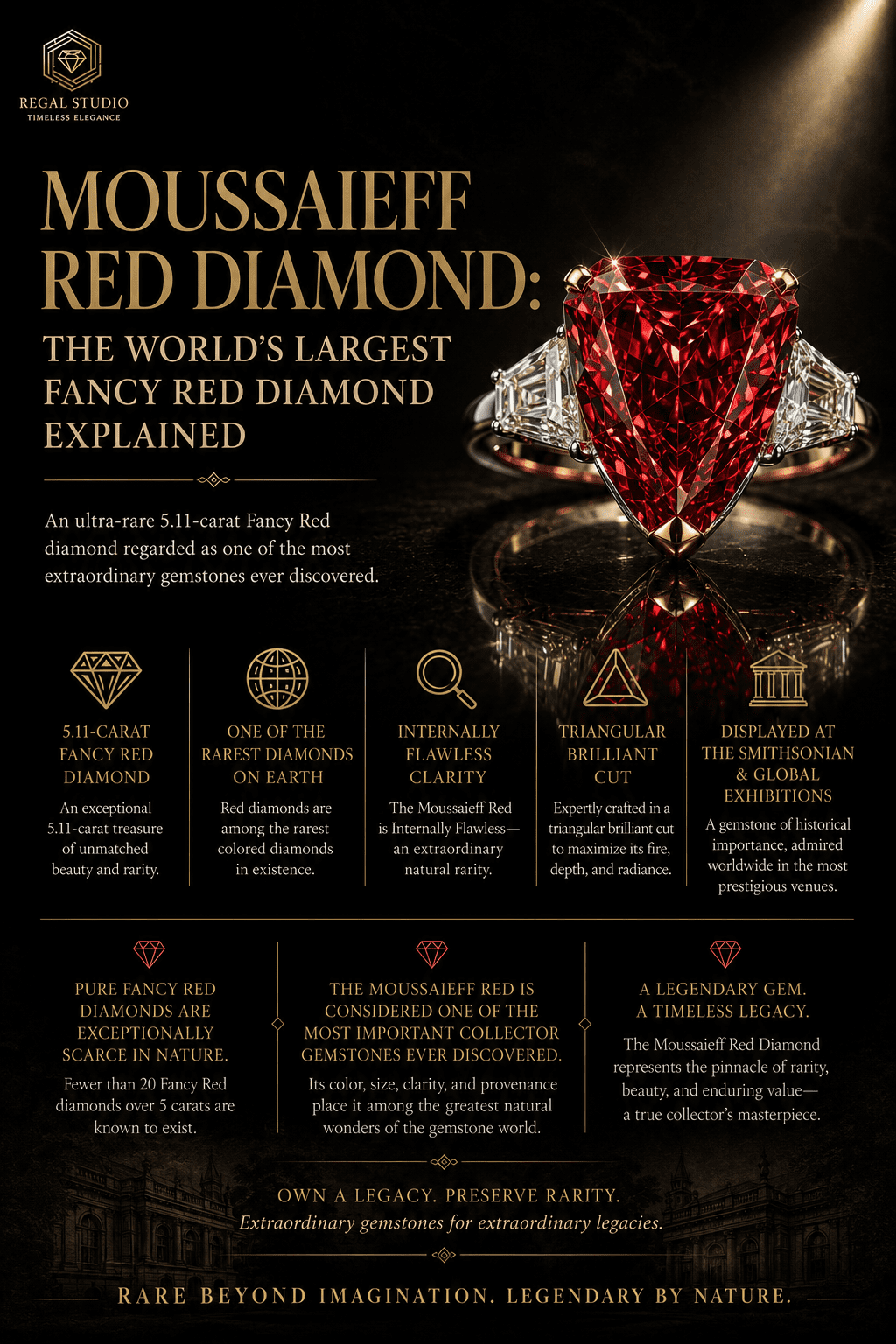


Moussaieff Red Diamond: The World’s Largest Fancy Red Diamond Explained
The Moussaieff Red Diamond is a 5.11-carat triangular brilliant-cut Fancy Red Internally Flawless diamond that holds the distinction of being the largest red diamond ever graded by the Gemological Institute of America (GIA). Discovered in 1990 by a Brazilian farmer named Ze Tatu in the Abaetézinho River in Minas Gerais, the original 13.90-carat rough was cut by William Goldberg Diamond Corporation into the spectacular triangular brilliant we know today. Originally named the Red Shield Diamond, it was purchased in 2001 by London jeweler Shlomo Moussaieff for approximately $8 million and remains in the Moussaieff family’s private collection. As fewer than 30 true natural red diamonds exist in the world (most under half a carat), the Moussaieff Red represents the absolute upper limit of what nature has ever produced in a Fancy Red diamond. Its current estimated value exceeds $20 million.
In our market observations across more than four decades of diamond grading and the high-end colored stone market, the Moussaieff Red is one of the three most consequential red diamonds in modern history, alongside the Hancock Red and the Argyle Phoenix. Experience has shown that understanding this single stone teaches more about the absolute apex of diamond rarity than almost any other gem in existence.
The Moussaieff Red Diamond at a Glance
Before exploring the full story, here are the essential facts every collector should know.
Attribute | Detail |
Carat weight | 5.11 carats |
Original rough weight | 13.90 carats |
GIA color grade | Fancy Red (only intensity grade for red diamonds) |
Clarity grade | Internally Flawless (IF) |
Cut | Triangular brilliant (trilliant) |
Diamond type | Type IIa (chemically purest) |
Color cause | Plastic deformation in crystal lattice |
Discovery year | 1990 |
Discovery location | Abaetézinho River, Minas Gerais, Brazil |
Discoverer | Brazilian garimpeiro named Ze Tatu |
Original cutter | William Goldberg Diamond Corporation, New York |
Original name | Red Shield Diamond |
Purchase year | 2001 |
Purchase price | Approximately $8 million |
Buyer | Shlomo Moussaieff (Moussaieff Jewellers, London) |
Current owner | Moussaieff family (private collection) |
Current estimated value | $20 million+ |
GIA grading note | Largest Fancy Red diamond ever graded by GIA |
Total known red diamonds | Fewer than 30 in the world |
A key insight often overlooked: the Moussaieff Red is the largest red diamond, but at 5.11 carats it would not even rank in the top 100 largest colorless diamonds. The world’s largest D-color diamonds (Cullinan I, Cullinan II, Centenary) weigh 530, 317, and 273 carats respectively. The Moussaieff Red’s significance comes entirely from its color, not its size.
Why the Moussaieff Red Diamond Is So Significant
The Moussaieff Red’s importance comes from six interlocking factors that combined to make this stone genuinely unique in the entire history of natural diamonds.
The six factors that make the Moussaieff Red exceptional:
- Color rarity: red is the absolute rarest of all diamond colors
- Size superiority: at 5.11 carats, it is dramatically larger than any other red diamond
- Color purity: pure Fancy Red with no modifying tones (very few red diamonds achieve this)
- Internally Flawless clarity: the highest clarity grade possible
- Type IIa chemistry: the chemically purest diamond category
- Documented Brazilian provenance: traceable to the Abaetézinho River discovery
Experience has shown that no single factor alone made the Moussaieff Red exceptional. The combination of all six in one stone is what makes it the most significant red diamond in existence.
The Brazilian Discovery: 1990
The Moussaieff Red’s origin story begins with one of the most dramatic discoveries in modern diamond history.
Ze Tatu and the Abaetézinho River
In 1990, a Brazilian garimpeiro (informal diamond prospector) named Ze Tatu was working in a manual digging operation in the district of Major Porto, in the Noroeste region of Minas Gerais state. His dig was located near the Abaetézinho River, an alluvial diamond mining area in Brazil’s Alto Paranaíba region known for producing exceptional colored diamonds.
What Ze Tatu uncovered was a 13.90-carat rough diamond crystal with an unusually deep red color. Brazilian alluvial deposits had historically yielded yellow, brown, and pink diamonds, but a true red diamond of this size was unprecedented.
Why the Discovery Mattered
In our professional assessment, the discovery of a 13.90-carat red rough crystal is statistically extraordinary. Most red diamonds in existence weigh less than half a carat. A rough crystal nearly 14 carats with red color suggested potential for the largest cut red diamond in history.
The geological context:
- Brazil’s Alto Paranaíba region has produced colored diamonds for centuries
- Alluvial deposits in the area are rich with rare-color stones
- The same general area has produced other significant fancy color diamonds
- The geological conditions there appear to favor crystal lattice deformation
A key insight often overlooked: the Moussaieff Red, the famous Hancock Red, and several other major red diamonds all came from Brazil’s Minas Gerais region. The geological conditions in this specific area appear uniquely suited to producing the plastic deformation that creates red color in diamonds.
William Goldberg and the Cutting Process
After the discovery, the rough red diamond was acquired by the William Goldberg Diamond Corporation of New York, one of the world’s most prestigious cutters of exceptional stones.
Why William Goldberg
William Goldberg Diamond Corporation has handled some of the most extraordinary diamonds in modern history, including the Guinea Star and the Premier Rose. The corporation’s reputation for cutting exceptional stones made them the natural choice for what would become the largest red diamond ever cut.
The Cutting Decision
Cutting a 13.90-carat red rough into a finished diamond required months of careful study. The master cutters faced a critical decision:
- Cut for maximum size (potentially compromising color saturation)
- Cut for maximum color depth (potentially sacrificing more carat weight)
- Cut for optimal balance (preserve significant size while maximizing red intensity)
The cutters chose the balanced approach, ultimately fashioning the rough into a modified triangular brilliant cut (also called a trilliant cut) weighing 5.11 carats. The triangular shape was selected to:
- Maximize visible color saturation across the table
- Preserve significant carat weight from the rough
- Optimize light return through the facets to enhance the red intensity
- Create a distinctive visual signature
The Yield
The cutting process sacrificed 8.79 carats from the original 13.90-carat rough, a yield of approximately 37%. While this might seem dramatic, it is normal for fancy color diamonds where preserving and enhancing color is more important than maximizing weight.
The finished 5.11-carat stone was originally named the Red Shield Diamond, a reference to both its triangular shield-like shape and its extraordinary place among the world’s most unusual gems.
In our market observations, the William Goldberg cutting work on the Moussaieff Red represents one of the most consequential cutting decisions in modern diamond history. A poor cut would have destroyed the stone’s potential. A skilled cut created the largest Fancy Red diamond in existence.

The 2001 Purchase by Shlomo Moussaieff
The Red Shield Diamond’s transition to its current name happened in 2001 with the purchase by one of the most prominent figures in 20th century diamond history.
Who Shlomo Moussaieff Was
Shlomo Moussaieff (1925-2015) was the founder of Moussaieff Jewellers, one of the world’s most prestigious jewelry houses with locations in London and other major luxury destinations. Born in Jerusalem to a family with deep roots in the diamond trade, Moussaieff built his eponymous firm into a globally recognized authority on rare colored diamonds.
The firm has handled some of the most extraordinary stones in modern history and counts members of royal families, ultra-high-net-worth collectors, and major institutions among its clientele.
The Purchase
In 2001, Shlomo Moussaieff purchased the Red Shield Diamond from William Goldberg Diamond Corporation for approximately $8 million. He immediately renamed the stone the Moussaieff Red Diamond in his family’s honor, establishing permanent brand association with one of the world’s most prestigious jewelry houses.
A key insight often overlooked: at $8 million for a 5.11-carat stone, the 2001 purchase price represented approximately $1.56 million per carat. This was extraordinary at the time but seems modest now. Current per-carat prices for high-quality red diamonds easily exceed $2-3 million per carat.
The Smithsonian Exhibitions
The Moussaieff Red has been displayed publicly twice at the Smithsonian Institution’s National Museum of Natural History in Washington, D.C., providing rare opportunities for the public to see one of the world’s most extraordinary diamonds.
The Splendor of Diamonds (2003)
From June 2 to September 30, 2003, the Moussaieff Red was featured in “The Splendor of Diamonds” exhibition alongside other legendary gems including:
- The De Beers Millennium Star
- The Pumpkin Diamond
- The Heart of Eternity
- The Ocean Dream
- The Steinmetz Pink
This exhibition represented one of the most significant public displays of legendary diamonds in modern history.
The Diamonds Exhibition (2005-2006)
From July 8, 2005 to February 26, 2006, the Moussaieff Red appeared again at the Smithsonian, this time alongside:
- The De Beers Millennium Star
- The Steinmetz Pink
- The Incomparable Diamond
- The Ocean Dream
- The Heart of Eternity
- The Allnatt Diamond
- The 616 Diamond (uncut)
- The Aurora Collection (296 naturally colored diamonds totaling 267.45 carats)
In our market observations, public exhibitions of the Moussaieff Red are extremely rare events. Most collectors and gemologists may go their entire careers without seeing the stone in person.
The Science Behind Red Diamond Color
Understanding why the Moussaieff Red is so extraordinary requires understanding what makes red diamonds chemically and geologically unique.
Why Red Diamonds Are Different
Unlike other colored diamonds that derive their color from chemical impurities, red diamonds form through an entirely different process.
How most colored diamonds get their color:
- Yellow diamonds: nitrogen impurities
- Blue diamonds: boron impurities (Type IIb)
- Green diamonds: natural radiation exposure
- Red diamonds: plastic deformation in crystal lattice (NO impurities)
Red diamonds are made of pure carbon, identical chemically to colorless Type IIa diamonds. The red color comes from a structural irregularity in the crystal lattice that occurs during the diamond’s formation deep within the Earth’s mantle.
The Plastic Deformation Process
When diamonds form deep underground, they typically grow in regular crystal patterns. Some diamonds, however, undergo intense shear forces and plastic deformation as they rise from the mantle to the surface during volcanic eruptions.
These deformations create distortions in the crystal lattice that absorb specific wavelengths of light. In red diamonds, the deformation absorbs blue and green light, leaving only red light to reflect back to the viewer.
The GIA Grading Anomaly
A critical fact about red diamonds: GIA does NOT issue intensity grades like “Fancy Vivid Red” or “Fancy Intense Red” the way it does for other colored diamonds. Red diamonds are graded only as:
- Fancy Red
- Fancy Brownish Red
- Fancy Purplish Red
- Fancy Orangey Red
This is because red is essentially a “hyper-concentrated” form of pink. There is no separate intensity scale because the color itself represents the maximum possible saturation.
A key insight often overlooked: any seller offering a “Fancy Vivid Red” or “Fancy Intense Red” diamond is either misinformed or attempting fraud. GIA does not issue these grades for red diamonds.
The Moussaieff Red in Context: World’s Largest Red Diamonds
To fully appreciate the Moussaieff Red’s significance, see how it compares to other significant red diamonds.
Diamond | Carats | Color | Cut | Status |
Moussaieff Red | 5.11 | Fancy Red | Triangular brilliant | Moussaieff Jewellers |
Unnamed “Red Diamond” | 5.05 | Fancy Red | Emerald cut | Anonymous private collector |
De Young Red | 5.03 | Fancy Brownish Red | Round brilliant | Smithsonian Institution |
Argyle Phoenix | 1.56 | Fancy Red | Round brilliant | Laurence Graff |
Hancock Red (Halphen Red) | 0.95 | Fancy Purplish Red | Round brilliant | Sold 1987 |
Argyle Everglow | 2.11 | Fancy Red | Radiant cut | Argyle Tender |
Heart-Shaped Red | 2.09 | Fancy Red | Heart shape | Christie’s $5.09M (2014) |
The Rob Red | 0.59 | Fancy Red | Pear shape | Private |
In our market observations, only three faceted red diamonds in the world exceed 5 carats: the Moussaieff Red (5.11), the unnamed “Red Diamond” (5.05), and the De Young Red (5.03). The Moussaieff is therefore not just the largest, but one of only three significant red diamonds in existence above the 5-carat threshold.
Why Red Diamonds Are the Rarest of All
The Moussaieff Red’s significance is impossible to understand without grasping just how rare red diamonds actually are.
The rarity statistics:
- According to GIA, only about 0.4% of diamonds graded over the past two decades have been fancy colors
- Among fancy colors, red diamonds represent the smallest fraction
- Fewer than 30 true natural red diamonds are known to exist worldwide
- Most documented red diamonds weigh less than 0.5 carats
- The Argyle mine in Australia (closed November 2020) produced a small percentage of these
- Brazilian alluvial deposits have produced the most significant pure red diamonds
The geological conditions required to produce a red diamond are so specific that the world may never see another stone of the Moussaieff Red’s quality and size. As one industry expert noted, the Moussaieff Red may represent the “upper limit of what nature is capable of producing in a true red diamond.”
A key insight often overlooked: red diamonds typically command per-carat prices exceeding $1 million, far higher than almost any other type of diamond. This is why even the smallest red diamonds (under 1 carat) sell for hundreds of thousands or millions of dollars.
What the Moussaieff Red Would Sell For Today
The Moussaieff Red has never been sold at public auction. It was purchased privately in 2001 for approximately $8 million and has remained in the Moussaieff family’s collection ever since. Estimating its current value requires understanding several modern reference points.
Current Market References
In 2014, a 2.09-carat heart-shaped Fancy Red diamond sold for $5.09 million at Christie’s, achieving $2.44 million per carat. In 2022, the 11.15-carat Williamson Pink Star achieved $5.18 million per carat at Sotheby’s Hong Kong, the current per-carat record for any diamond.
If the Moussaieff Red were to appear at auction today, conservative estimates would value it well above $20 million, with some experts suggesting it could approach or exceed the per-carat record currently held by the Williamson Pink Star.
The Provenance Premium
Red diamonds with documented Brazilian provenance command additional premiums over other red diamonds. The Moussaieff Red’s combination of:
- Largest size in its category (5.11 carats)
- Pure Fancy Red color with no modifying tones
- Internally Flawless clarity
- Type IIa chemistry
- Documented Brazilian provenance
- Two Smithsonian exhibition appearances
would likely make it the highest-valued red diamond ever offered at auction.
In our professional assessment, the Moussaieff family is unlikely to sell the diamond in the foreseeable future. Stones of this caliber typically remain in family collections for generations once acquired.

The Type IIa Chemistry Connection
The Moussaieff Red is classified as a Type IIa diamond, the chemically purest category, which adds to its exceptional value.
What Type IIa Means
Type IIa diamonds are free from nitrogen and boron impurities. They make up only 1-2% of all diamonds and represent the purest form of carbon crystal in nature.
Famous Type IIa diamonds include:
- The Cullinan Diamond and its famous descendants (Cullinan I and II)
- The Koh-i-Noor
- The Centenary Diamond
- The Pink Star
- The Graff Pink
- The Williamson Pink Star
- The Moussaieff Red (this article’s subject)
For a red diamond to also be Type IIa is exceptional. The combination of the rarest color category with the chemically purest diamond type places the Moussaieff Red in a category occupied by perhaps a dozen documented stones in the world.
A key insight often overlooked: Type IIa diamonds typically command meaningful premiums over Type Ia diamonds. The Moussaieff Red’s Type IIa designation is part of what makes it irreplaceable.
What the Moussaieff Red Teaches Today’s Buyers
For collectors and investors, the Moussaieff Red story offers four practical lessons that apply at any budget level.
Four lessons from the Moussaieff Red:
- Color category matters more than size for fancy colors. A 5.11-carat red diamond commands prices that 50-carat colorless diamonds rarely achieve. Understanding which color categories carry premium value is essential for evaluating any colored diamond purchase.
- Master cutting work is part of the value. The William Goldberg cut transformed a 13.90-carat rough into a 5.11-carat masterpiece. Cutting craftsmanship affects the value of every quality diamond purchase, regardless of size or color.
- Type IIa designation should be confirmed for premium purchases. Any colored diamond at a premium price point should carry GIA documentation confirming Type IIa or Type IIb chemistry as appropriate. This is a fundamental authentication signal.
- A trusted jeweler relationship is the only reliable defense against misrepresentation. Experience has shown that the technical complexity of red diamond authentication, the rarity of legitimate stones, and the prevalence of treated alternatives demand expertise no individual buyer can match alone.
Expert Analysis: Five Truths About the Moussaieff Red Diamond
In our market observations across more than four decades of diamond expertise, the Moussaieff Red represents five patterns that shape colored diamond economics.
Five insights from the bench:
- The Moussaieff Red likely represents the upper limit of natural red diamonds. Experience has shown that nature has produced fewer than 30 true red diamonds in known history, with only three exceeding 5 carats. The Moussaieff may stand as the largest Fancy Red diamond for centuries to come.
- The 1990 discovery in Brazil was a once-in-generations event. The Abaetézinho River area has produced colored diamonds for centuries, but a 13.90-carat red rough crystal of the quality found by Ze Tatu may not appear again in the lifetimes of anyone reading this article.
- The William Goldberg cut is itself a masterpiece. The decision to fashion the rough into a triangular brilliant rather than a more traditional shape preserved both color saturation and significant carat weight. This cutting decision transformed a rough crystal into a globally recognized icon.
- The Smithsonian exhibitions (2003, 2005-2006) preserved cultural awareness. Public access to legendary diamonds is increasingly rare. The Smithsonian’s role in displaying the Moussaieff Red alongside other extraordinary stones expanded global appreciation for what red diamonds represent.
- A trusted jeweler relationship matters more for red diamonds than for any colored diamond category. The technical complexity of red diamond authentication, the prevalence of color-treated alternatives, and the extraordinary per-carat values demand expertise that takes decades to develop.
How GIA Experts Authenticate Red Diamonds
Beyond standard diamond authentication, professional red diamond evaluation includes:
- Color origin determination: natural vs. treated (5-10x value difference)
- Color modifier identification: pure red vs. brownish vs. purplish vs. orangey
- GIA grading rule verification: ensuring no false “Fancy Vivid Red” claims
- Type designation: Type IIa confirmation via spectroscopy
- Plastic deformation analysis: visualizing the lattice distortion
- Provenance verification: especially important for Brazilian-origin stones
- Spectroscopic analysis: confirms natural color origin
Buyers can learn the basics. Mastering red diamond authentication takes years of dedicated study. That is why a relationship with a GIA Certified Diamond Grader is essential for any serious red diamond purchase.
Frequently Asked Questions About the Moussaieff Red Diamond
How big is the Moussaieff Red Diamond?
The Moussaieff Red Diamond weighs 5.11 carats in its finished triangular brilliant cut. While this would not be considered large for a colorless diamond (where stones over 100 carats exist), the Moussaieff is the largest Fancy Red diamond ever graded by the Gemological Institute of America. The original rough crystal weighed 13.90 carats before being cut by William Goldberg Diamond Corporation in New York.How was the Moussaieff Red Diamond discovered?
The Moussaieff Red was discovered in 1990 by a Brazilian garimpeiro (informal diamond prospector) named Ze Tatu in a manual digging operation near the Abaetézinho River in Minas Gerais, Brazil. The 13.90-carat rough crystal was found in alluvial deposits in the Alto Paranaíba region, an area historically known for producing fancy color diamonds. The discovery was extraordinary because true red diamonds are typically found in sizes under half a carat.How much is the Moussaieff Red Diamond worth?
The Moussaieff Red Diamond was purchased by Shlomo Moussaieff in 2001 for approximately $8 million. Current expert estimates value the diamond at over $20 million, with some suggesting it could fetch significantly more if offered at auction today. If sold publicly, it could potentially challenge the per-carat record of $5.18 million per carat held by the Williamson Pink Star (sold by Sotheby’s in 2022). The Moussaieff family has not indicated any intention to sell.Why are red diamonds so rare?
Red diamonds are the rarest of all diamond colors. Fewer than 30 true natural red diamonds are known to exist in the entire world, with most weighing less than half a carat. Unlike other colored diamonds, red color does not come from chemical impurities. Instead, it forms from plastic deformation in the diamond’s crystal lattice during volcanic transport from the Earth’s mantle. The geological conditions required are so specific that producing a red diamond is statistically extraordinary, and producing one larger than 1 carat is genuinely once-in-a-generation rare.Where is the Moussaieff Red Diamond now?
The Moussaieff Red Diamond is currently held in the private collection of the Moussaieff family at Moussaieff Jewellers in London. It has been publicly displayed twice at the Smithsonian Institution’s National Museum of Natural History in Washington, D.C., once in “The Splendor of Diamonds” exhibition (2003) and again in “The Diamonds” exhibition (2005-2006). It has not appeared publicly in over a decade and is not expected to return to public display in the foreseeable future.
Key Takeaways: The Moussaieff Red Diamond
- The Moussaieff Red is the largest Fancy Red diamond ever graded by GIA at 5.11 carats
- It was discovered in 1990 in Brazil’s Abaetézinho River by a garimpeiro named Ze Tatu
- The 13.90-carat rough was cut by William Goldberg Diamond Corporation into the current triangular brilliant
- Originally named the Red Shield Diamond, it was renamed in 2001 after Shlomo Moussaieff’s $8M purchase
- It is one of only three known faceted red diamonds exceeding 5 carats
- Red diamonds get their color from plastic deformation in the crystal lattice, not chemical impurities
- Fewer than 30 true natural red diamonds exist in the entire world
- The diamond is currently estimated to be worth over $20 million
Final Thoughts: What the Moussaieff Red Story Means for Today’s Diamond Buyers
The Moussaieff Red Diamond is more than a record-breaking gemstone. It is a 30+ year reminder that nature occasionally produces objects so rare and beautiful that they redefine what we thought possible. The same principles that made the Moussaieff Red the largest Fancy Red diamond in history also shape the way master jewelers approach every quality diamond purchase today, just on a dramatically different scale.
You may never own a 5.11-carat Type IIa Fancy Red Internally Flawless diamond. But the principles that define the Moussaieff Red’s value apply to every quality diamond you might consider. Color matters. Cutting craftsmanship matters. Type designation matters. Provenance matters. And the right expert guidance turns those principles into a piece you actually want to own.
That is exactly what Mack has spent more than four decades doing at Regal Studio in Buckhead, Atlanta. As a GIA Certified Diamond Grader with 45+ years of experience, Mack personally evaluates every diamond that enters the studio, from classic colorless stones to fancy color selections for clients seeking the rarest categories. He has crafted custom pieces for everyday couples, celebrities, and professional athletes alike, applying the same rigor to a $5,000 engagement ring that auction houses apply to museum-grade stones like the Moussaieff Red.
Because natural red diamonds are among the rarest gemstones in the world, they are often chosen for highly personalized custom jewelry pieces rather than mass-produced settings. At Regal Studio, Mack works directly with clients in Atlanta to create custom jewelry designs around rare and investment-grade diamonds, with careful attention to ethical sourcing, authenticity, color evaluation, treatment disclosure, and long-term value.
Ready to work with the same diamond expertise that legendary stones deserve?
Visit Regal Studio on Peachtree Road in Buckhead, Atlanta, or get in touch to schedule your private consultation with Mack. Whether you are designing a custom engagement ring, sourcing a rare colored diamond, or restoring a family heirloom, you work directly with a master jeweler who knows the difference between every grade, every cut, and every story a diamond can tell.
You may not own the Moussaieff Red. But you can own something built with the same standards.
Mack’s motto says it all: “You Dream It, We Make It.”
Read More:
How Many Red Diamonds Are Left in the World? The Complete 2026 Count
The Best Custom Engagement Rings in Atlanta: What to Look For and Where to Buy